Pages

Performer Profile: Matthew Calderon

Matthew Calderon, 15 years old, hails from Los Baños, Laguna. He recently brought honor to the country when he placed 2nd in the 2012 Thailand Mozart International Competition.

300+ Pianists Prep for Record-Breaking Piano Concert

Never shall Filipinos witness another conglomeration of pianists such as this. Thus begins the journey towards the much-awaited grand 40-piano concert on November 18 this year at the Tanghalang Nicanor Abelardo of the Cultural Center of the Philippines.

Things to get you stoking: What to expect in PTGP's Forte@40

With barely 2 weeks left until the PTGP's much-awaited Forte @ 40 concert, more people are finding themselves increasingly psyched up for this budding mega event. What has previously been grapevine information transmitted via hushed undertones is now a full-blown hype that's taking traditional and social media by storm.

Lorenzo Medel plays Rach 2 with MSO

Following his successful AHA debut last December 6, piano prodigy Lorenzo Medel is once again set to conquer the stage as he performs in a solo piano recital on January 12, 2013 at the Philamlife Auditorium, UN Avenue, Manila.

Monday, June 24, 2013

Cecile Licad's Lisztian affair with the ABS-CBN Philharmonic Orchestra


When I first heard about this concert, my initial thoughts were, "Liszt... again?" I just came out of a concert featuring Liszt's 2nd concerto at the time, and being the borderline personality that I am, I figured I could do with some variety.

But after factoring in several things, I eventually got swayed into watching it: 1) I've been hearing a lot of buzz about ABS-CBN Philharmonic Orchestra and its conductor, Gerard Salonga, and if I'd want to become the concert connoisseur I intend to be, I'd have to at least prime myself with all the orchestras around, this burgeoning entity a non-exception; 2) It's going to feature Cecile Licad, for chrissakes! Enough said! And: 3) BECAUSE TOTENTANZ (They had to hold the repertoire info from concert-goers beforehand to brew suspense. I guess it worked, to some degree.)

Okay--I know I've been rash in dismissing this concert to be another Liszt affair that features one of his not-so-stellar concertos, which is why I couldn't help but be guilty-excited the moment I learned that this notoriously difficult showpiece was in the set list. And who better to initiate me to a live Totentanz experience than one of the country's most renowned classical pianist--who, in all abashedness, I haven't seen perform live yet?

And so just like any other concert I've attended in the past, this will probably bring me some monumental firsts which are most certainly not worth forgetting.

I might have hyped over Totentanz a little bit too much, so just to let readers know, the concert also features other Liszt masterpieces, such as Symphonic Poem No. 2 Tasso, Lamento e Trionfo, S. 96, and his more famous concerto Piano Concerto No. 1 in E-flat Major, S. 124, also to be played by Ms. Licad.

And as if that night could handle all the epicness in the world, ABS-CBN Philhamornic also lined up Beethoven's Egmont Overture op. 84 and Saint-SaĂ«ns' Danse Macabre Op. 40, two perennial concert favorites.

So "The Pianist's Pianist" it shall be.

Thursday, May 9, 2013

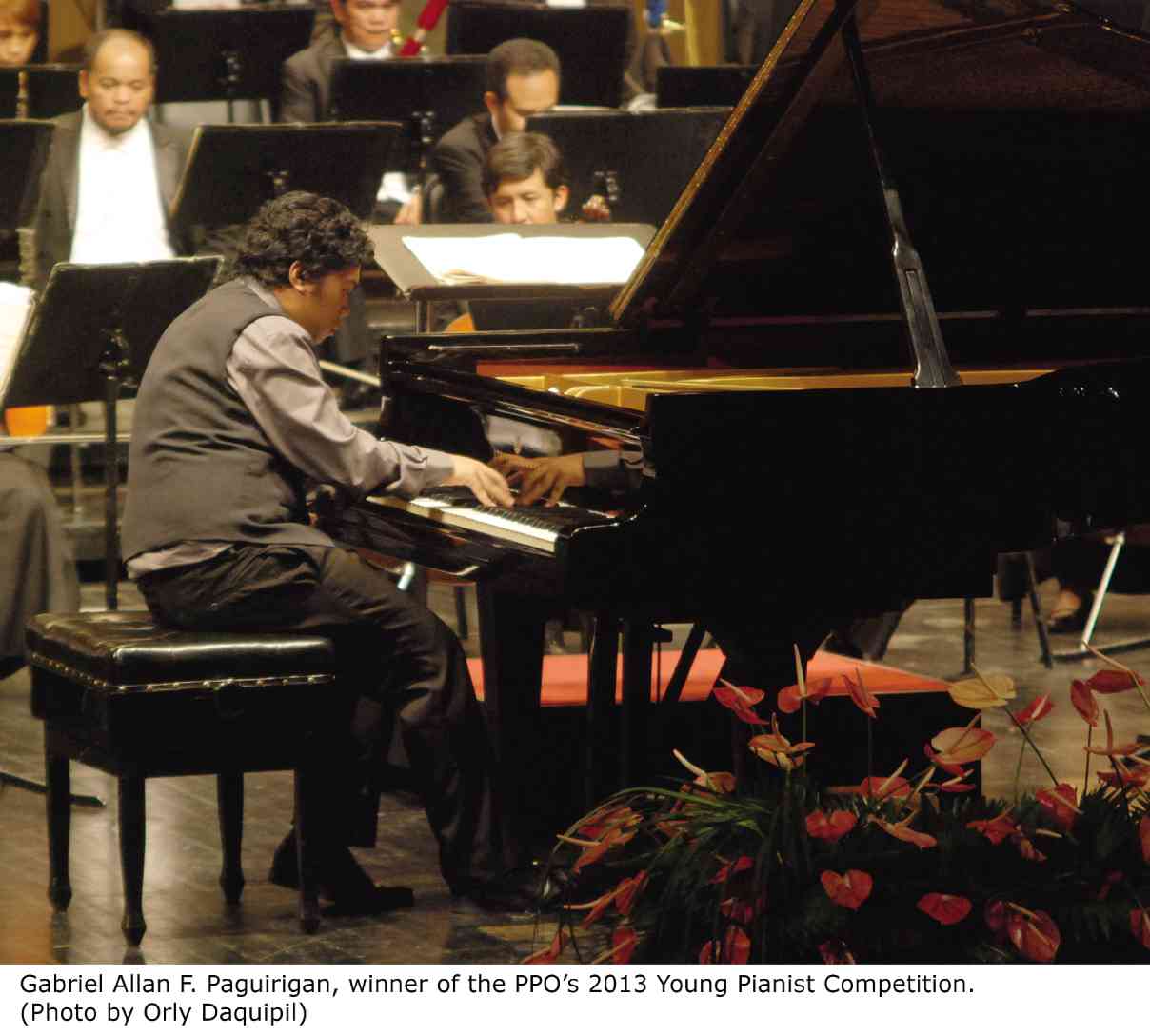
Gabriel Allan Paguirigan's second bite of the cherry


After his amazing rendition of Saint-SaĂ«n's piano concerto no. 2 in G minor August of last year, Gabriel Allan Paguirigan once again took center stage with the Philippine Philharmonic Orchestra when he played Liszt's piano concerto no. 2 in A mjor during its "Mahler's Fifth" concert last April 4, 2013. This came after he won PPO's 2013 Young Pianist Competition, which I found not at all surprising.

What I did find surprising, however, was the boy behind the virtuoso. For someone so awfully talented, he is awfully friendly and modest, so much so that when I finally got around to asking him for an interview, he immediately agreed. He's quite the character, that kid.

Get to learn more about our little national treasure in this little interview. Quick, before he flies to Europe!

Image credit: Philippine Daily Inquirer
So you got to be a part of the PPO's season-ender concert last month. How did you feel about the experience?

It was a very memorable performance. Not everyone gets the chance to perform with the PPO. I feel very blessed and happy.

It is your second time playing with the orchestra, the first time was during the Classical Champs concert where you played Saint-Saën's piano concerto no. 2. How did it feel during the second time and how does it compare to your first?

The second time is more special to me. I never thought that I'd be featured as soloist in PPO's season concert, and definitely not in a season-ender. It was also easier for me the second time I worked with Maestro Oli and PPO. I remember the first time I rehearsed with maestro and PPO, I was really overwhelmed by the sound of the orchestra that I couldn't focus on my playing. But this time, I was more comfortable in playing, and of course the Liszt concerto was more straightforward than Saint-Saens' no.2, thus making it easier to put together with the orchestra.

You won your way into obtaining that coveted "guest artist" spot. Tell me about your competition experience: how long were the preparations and how did you prepare?

Actually, my teacher and I were informed around 2 weeks before the competition. Good thing, I was preparing the Liszt concerto for my solo recital (which took place April, around one week before the concert), so we decided to join. Preparing for competitions have always been tough for me. Short notice performances/competitions would really require intelligent practice. It's really quality over quantity. And of course, everytime I participate in competitions, I don't expect anything. I set my mind that it's just a performance and winning is just a bonus. Winning this competition came as a surprise to me, seeing who the competitors were and knowing how good they are. I really didn't expect to win.

Image credit: NiceyArafiles.com
Whenever I hear your interpretations, especially those amazing 2nd movements, I can feel that you have a some sort of "connection" with the moment (read: may pinanghuhugutan). Where do you harness these emotions that you express through your music?

In my opinion, a musician should have two perspectives when practicing and performing: performer and listener. The performer connects with the instrument while the listener connects with the music. I guess I'm more of the listener when I play. I try to relate to what the music tells. To be able to convince the audience, I make sure that I also convince myself. That's probably why you say I have this connection with the moment.

I just had to ask: What do winning pianists like you listen to? What are your musical preferences?

I can't end a day without listening to Bach. I love listening to his compositions! Who doesn't anyway? I feel really grateful to Petri, Busoni, and Rachmaninov--among others--for expanding the piano repertoire with transcriptions of Bach's instrumental and vocal works.

What are your plans for the future?

I'm still not sure.  Most probably, I'd continue my studies  in music abroad.  I just hope I could get a scholarship.


Gabby is taking up Diploma in Creative and Performing Musical Arts (DCPMA) at University of the Philippines, Diliman.  He is currently studying piano under the tutelage of Ms. Nita Abrogar-Quinto.

Wednesday, April 17, 2013

PPO VIII: Mahler's Fifth


So why must you watch PPO's 2012-2013 season finale?

Two words: MAHLER's FIFTH. Enough said.

On April 4, 2013, the Philippine Philharmonic Orchestra (PPO), under the baton of Olivier Ochanine, will cap off its 30th season with a concert billed as "Mahler's Fifth."  This is a momentous occasion for me, as it marks the end of my first season as a PPO regular (if I could actually call myself that). So this coming Friday, by hook or by crook, I'd be at CCP's Tanghalang Nicanor Abelardo before 8PM to witness this once-in-a-lifetime performance by my favorite local orchestra.

For the past weeks, Maestro Ochanine has been stoking everyone's interest with Facebook posts which dropped several hints regarding the concert's program. I now know that Gustav Mahler's Fifth Symphony (the concert's namesake and centerpiece) is one of the most revered masterpiece in the entire orchestral music literature.  At over an hour in length, it is by no means an amateur's piece. In a Facebook post, Maestro Ochanine expressed his awe at the sheer grandeur of the work, stating: "I feel extremely lucky. This work is sublime. I feel unworthy, yet am excited to give it the best I can give." 

"The Philippine Philharmonic Orchestra will dazzle concertgoers with this one for sure," he added.

For what it's worth, I am most excited to hear the symphony's 4th movement, the "Adagietto." It's probably the most exquisite piece of music my ears have ever heard and it never fails to bring me eargasms each time I play it. I can't wait to hear it live, just because I don't think I'll be able to hold back them tears once they get to the most dramatic part.

I heard Herbert von Karajan, the great Austrian conductor, once said that "a great performance of the Fifth is a transforming experience." I guess that could count a another reason for people to hear the PPO play Mahler's Fifth: to have a shot at transforming their dreary lives. I kid, of course. Then again, that might also be one of my reasons, so who knows?


Another factor which got me really pumped up for this concert is Gabriel Allan Paguirigan, an up-and-coming concert pianist who I hold in high regard. I've had the honor of watching him play Camille Saint-SaĂ«ns' piano concerto no. 2 in G minor last August, and I can't wait to watch him tangle fingers with Franz Liszt's Piano Concerto no. 2 in A major this coming Friday. He was chosen to be the guest soloist for the concert after he won in the 2013 Young Pianist Competition held last March 6, 2013, besting some of the country's best young pianists for the coveted spot.

Gabriel Allan Paguirigan
Image credit: NiceyArafiles.com
Apart from the abovementioned pieces, the PPO will also be playing Wolfgang Amadeus Mozart's Overture to Cossì Fan Tutte.  

Tickets are available at P1,000, P800, P500, P350, and P200, with discounts available to students, senior citizens and groups. Earlier this week, Maestro Ochanine announced that as a special promotion for the PPO's 2012-2013 finale, those who will purchase tickets at regular prices will be allowed to bring a companion for free.

For inquiries, call the CCP Marketing Department at tel. 832-1125 loc. 1806; CCP Box Office (832-3704) or Ticketworld at 891-9999.

Wednesday, April 10, 2013

PTGP Seminar Series VI: The road towards the 2013 piano festival


On April 14, 2013, the Piano Teachers' Guild of the Philippines, Inc (PTGP) will host the sixth installment of its successful seminar series.  Themed "2013 Piano Festival: Composers of Nationalistic Themes," the seminar will be conducted by Prof. Mauricia Borromeo and will be held at the Rehearsal Hall of St. Scholastica's College, Manila.

Dr. Mauricia Borromeo is widely known and respected for being a long-time professor and dean at the University of Philippines' College of Music where she taught piano performance, music theory, and music education. She has since then become a sough-after resource speaker in various regional and national conventions and seminars on music education. True to her dedication in piano pedagogy, she has served two terms as the president of the PTGP.  Prof. Borromeo, alongside Fr. Manuel Maramba, OSB, currently acts the PTGP's adviser.

The seminar's theme is in congruence with PTGP's upcoming 2013 piano festival which will center on the works of composers of nationalistic themes.

Seminar fee is P100 for non-members and P50 for students. Admission is free to all guild members.

Thursday, March 21, 2013

The Maestro's Maestro: A night of French music with conductor Mark Gibson and violinist Gao Can

You've heard the maestro.  Now it's time to hear the teacher.

As suggested by its theme, "The Maestro's Maestro," the Philippine Philharmonic Orchestra's latest concert features Mark Gibson, Olivier Ochanine's conducting mentor, as he leads the PPO in its upcoming performance on March 22, 2013, 8PM, at the Cultural Center of the Philippines' Tangahalng Nicanor Abelardo.

Image credit: http://ccmopera.com

Mark Gibson boasts of an impressive portfolio, having conducted various orchestras and ensembles in both opera houses and concert halls.  He is currently on his fourth year as Artistic Director of the Opera Theatre and Music Festival of Lucca and is currently the head Orchestral Studies program at the College-Conservatory of Music, University of Cincinnati—all while maintaining an active performing career across three continents.

Image credit: http://criticaclassica.wordpress.com

Joining the PPO is guest soloist Gao Can, a Chinese violinist who is considered as one of the most versatile young violinists in his country today.  He has received many domestic and international distinctions, including the Grand Prize during the 2006 China’s National Violin Competition, a special Recognition Award at the Michael Hill International Violin Competition in 2007, and the Second prize and a Special Award from the 2008 Naples “Alberto Curci” International Violin Competition.  His most recent achievement is the "Highest Violin Award" which he received during the 2009 Ima Hogg International Young Artist’s Competition.

The programme consists of selected works from great French composers.  The PPO will play George Bizet's Petite Suite from "Jeux d'Enfants," Maurice Ravel's "Daphnis et Chloe," and Camille Saint-SaĂ«ns' "Violin Concerto No. 3 in B minor" with Gao Can as the featured soloist.


Tickets are available at P1,000, P800, P500, P350, and P200, with discounts available to students, senior citizens and groups. To purchase tickets, call the CCP Marketing Department at tel. 832-1125 loc. 1806; CCP Box Office (832-3704) or Ticketworld at National Book Store (891-9999).

Tuesday, March 12, 2013

"ENOUGH! Time to bring back performance respect!" by Olivier Ochanine

I have to admit, I'm fairly new in the classical music scene here in Metro Manila. That doesn't mean I can't empathize in the pet peeves of tenured concert-goers, however. And although I've yet to see every antic, the inconsiderate rowdiness of some audiences alone can strike a nerve.

Too bad I can't bitch slap them garrulous mouths right then and there.

In a Facebook note, PPO conductor Maestro Olivier Ochanine took the words right out of my mouth and straightforwardly expressed what needed to be expressed. He spoke not only for himself, but for everyone who loves music and enjoys the ineffable purity of a great live performance.

Read, and be informed.


I've had it.  Enough is enough.  Time for some frank and blunt words.  And before some people accuse me of being a non-Filipino jerk who likes to complain about a culture of which he is not originally a part, let's understand one thing: music (or the arts), to which this pertains, is not specifically about the Philippines, or any other country.  It is about humanity and the need for all of us to express ourselves.  And, just like the need to express ourselves, we have the need to experience others expressing themselves.  It's part of a civil society!

Here is the dilemma:

Before moving to Manila, I was a regular concertgoer, whether it was to hear the LA Philharmonic, Cincinnati Symphony, or even university groups and soloists.  It was necessary for me; I needed it in order to feel fulfilled and healthy.  This is not so say that concerts were attended solely by well behaved concertgoers; we've always had our share of candywrapper folks and chronic coughers.  But - at least - once you were seated, it was pretty impossible to leave the hall, and it certainly was impossible to interrupt a performance by entering in the middle of it.  This was because ushers were decently trained, which means they refused entry to anyone that was late - no exceptions.  It was also because people understood the concept of respecting the performance atmosphere, from performer to fellow audience. Like I said, there were some exceptions, but overall, it was enjoyable to attend concerts.

Here are my blunt words, which some in Manila will not like to read; I imagine, however, that those who respect music and need it in order to breathe feel exactly the same way I do.  If they do not feel this way, I presume they are part of the problem.

ATTENDING ROWDY CONCERTS 

As long as I've lived in Manila, it has been virtually impossible to attend a concert or theater production (plays/musicals) wherein I was truly able to immerse myself in the experience.  It never has failed; people talking like they are at a bar, people casually walking in and out of the performance venue multiple times as if they were in their living room, or cell phones going off.  I'll never forget a performance by Rachelle Gerodias and Arthur Espiritu a couple years back, during which a cell phone alarm kept going off for several minutes without the owner doing a thing about it!!  This even happened three times before finally an audience member yelled 'would the idiot with the cell phone please turn the thing off or leave!!?'.  

Have we lost our marbles?  Or just a sense of decency and respect for our fellow human beings?  I'm not even referring solely to respect for the performers, but also for the audience members who have come to experience the most sublime of communication - music.

Earlier today, I attended a performance during which I experienced all the following:
1. some woman unwrapping her candy over the course of 3 minutes, not even caring to do it under her legs or inside her purse - just right in the open!

2. a young man (in VERY casual shorts) walking in and out in the middle of a serene musical moment on stage, as if he was king
3. a videographer who constantly stepped up on a squeaky ladder to monitor her recording (in the front row, mind you!)
4. hordes of people being allowed to enter in the middle of a Chopin piano concerto, slamming their seats down and giggling as they settled in

Why does this all anger me?  Simple.  It happens at EVERY performance I attend, and my need for cultural fulfillment is at an all time low.  Recently, I attended a performance of the Taiwan National Symphony Orchestra in Taipei's national concert hall, and that really helped me a little to regain some sanity.

What really angers me with all of this though?  This problem can and should be fixed in the schools, and yet all recitals I've attended at UP, UST and some other schools have the same atmosphere.  I find that music teachers should not be allowing this to happen.  How can we teach music students the importance of making music and not simply playing notes when we do not enforce the necessity for a conducive performance environment?  If we expect the public to respect our performers, we must teach our performers to respect each other, starting at the college level if not before.

ELITISM VERSUS RESPECT 

Am I preaching that classical music or theater should promote an aura of elitism?  Absolutely not.  What I believe is that, for far too long, we have associated respect with elitism.  Attending a performance and respecting those who are working so hard to bring us the experience is a FAR CRY from acting elitist!

It is too easy to play victim here.  The simple fact is that we as a society, whether in Manila or elsewhere, are losing respect for one another.  We take each other for granted.  Modern technology is probably the biggest culprit (decimating our attention spans and erasing our personalities).  However, as hard as it can be for us to sit still during a performance, let's always remember that these difficulties can be tenfold as a performer on stage.  Let's add to that a disruptive audience who cares not at all for the energy that should be shared between performer and audience, and we have a lost performance.  Sure, we have notes.  But when did notes ever move us?  Believe me, they never do.  Notes mean nothing.  Music means everything, and without the right energy, aura and personality, music does not exist.

Performing artists require a very particular type of focus.  This is not the focus we need when driving a car, or reading a book.  This is completely different altogether.  Interpreting a work, whether musical or theatrical, requires either complete silence (if we perform for ourselves) or complete silence plus a shared energy.  When we respect our performers by sitting still and sharing the moment with them, we are respecting the hours, days and months they have put into breathing life into the notes or words at hand.  When we do any of the things listed above, we are spitting in their face, crapping on their talent, and tearing down the construct of a civilized society little by little.

I want to mention another aspect of respect as well.  In general, Filipinos are very respectful of their elders.  The word 'po' is used for those who are older, and this is a culture that respects older people more than almost any culture I've encountered.  That is superb, in my opinion. 

But what of those who are no longer living?  Should we not respect them, too?  This goes also for composers whose works we perform.  Dead or alive, composers deserve a respectful audience.

ENERGY BEGETS ENERGY

For those who are new to the concept of shared energy in performances, or for those who need a refresher, let me state it simply.  When we are good audience members (i.e. being still, quiet and listening carefully), we become a part of the performance!  There are performances, by the way, that at times benefit from participative audiences, such as pop music, or holiday concerts, among others.

As a conductor, flutist and contrabassist, I have performed countless times in my life, for all sorts of crowds.  My most memorable experiences have not necessarily been the biggest crowds or the best halls in which I performed.  They have been the performances for audiences whose energy interacted with mine to create something indescribable.  For classical music, even the quietest audiences have a certain energy that a performer feels, and from which the performer can gather a cyclic energy that helps the performance.  

Cell phones can kill a performance.  During a performance of Mahler's 9th Symphony at the New York Philharmonic, a cell phone near the front row was going off.  The symphony was stopped and they had to start up again.  Even if conductor Alan Gilbert had decided to continue in the symphony, the moment had been killed.

WHAT MUST BE DONE

You see, this happens all over the world.  I'm certainly not implying that Manila is unique to this.  What I am stating is that the schools must work to fix this very real problem, because otherwise music in Manila will never be taken seriously, or be as intimate as it can be; if musicians do not take each other seriously, how will the public?

As a proud Manila inhabitant for the past three years, I want the best for the arts community here.  Those who have read my writings know that I think very highly of the talent pool in the country and that I yearn for a better outlet for all Filipinos to express themselves, develop their talents and share their talents with the rest of the world.

I beseech the schools to work toward solving the problem of shabby performance environments.  The rudiments of music include proper etiquette, both as a performer and as a concert goer.  Part of the curriculum must delve into this aspect.  Even the performers must be taught the crucial elements - i.e. leave your music on your stand after performing and first acknowledge your audience.  I am told the late Erlinda Fule, dean of the UST school of music, was notorious for locking the doors of the performance venues after concerts had started.  That's the spirit!  What has happened since her reign?

If the schools can focus on the absolute importance of respect, we will go a long way here in Manila toward elevating our artists. 

What else can be done?  Usherings services must be improved.  Very simply put, latecomers must not be allowed in!  We are teaching people that coming late to performances is very acceptable.  NO MORE!

'Filipino time' (which Filipinos do not mind mentioning all the time, even if jokingly) has no place in the performance venue.  The performer made sure to start on time, and audience members better make sure to be there at the beginning or wait until after intermission or at least between major works.   We can all be late (emergencies happen), but ushers should not allow us in during the middle of a performance.  

SUMMATION

I hope my readers do not take offense.  As I said at the beginning, those who do are quite possibly those who do not feel as passionately about music or the arts as I do (or as many of my colleagues do, for that matter).  Let's stop being selfish; let's respect one another and feed positive energy into each performance we attend.  

I also hope the schools will take note and take this a little more seriously.

Monday, March 4, 2013

Nostalgic Symphony: Oscar Yatco takes the baton in PPO homecoming concert


In continuing celebration of its 40th founding anniversary celebration, the Philippine Philharmonic Orchestra pays homage to its roots as it welcomes back one of the most important figures to have ever graced its colorful history--Prof. Oscar Yatco.  After almost three years, Yatco will once again lead the PPO in a concert on March 6, 2013, 8PM, at the CCP's Tanghalang Aurelio Tolentino (Little Theater).

The repertoire consists of famous overtures by renowned Romantic opera composers Richard Wagner and Giuseppe Verdi, both of whom are celebrating their 200th birth anniversary this year.  During the first part of the program, the PPO will perform I Vespri siciliani Overture by Verdi and also the Tannhauser Overture by Wagner.  The second part, however, slightly veers awat from the course as the PPO takes on Tchaikovsky's emotionally-charged  Symphony No. 6 Op. 74 in B minor (“Pathetique”).

Prof. Yatco, 81 years old and already based in Germany, started off in the industry as a violinist and was able to obtain his Teacher's Diploma for Violin from the College of Music at just 16 years old.  He went on to continue his violin studies at the prestigious Juilliard School of  Music under the tutelage of Ivan Galamian.  He also studied in Germany at the Munich Music Academy under Wilheim Stross.  

When he came back to the Philippines in 1964, he became a driving force behind the unprecedented development of the Manila Symphony Orchestra (MSO).  He was also instrumental in the early development the Philippine Philharmonic Orchestra, having been its conductor during the '80s back when the PPO was still newly established.

The "Nostalgic Symphony" concert will serve as Oscar Yatco's homecoming concert with the PPO.

Buy your tickets by calling the CCP Box Office at (632) 8323704/06 or by visiting www.culturalcenter.gov.ph.

Friday, March 1, 2013

In memoriam: Van Cliburn (1934-2013)

Van Cliburn, one of America's premier pianists, died on February 27, 2013 in Fort Worth, Texas, following a long bout with bone cancer.  He was 78 years old.

Image credit: http://music.yahoo.com

The Van Cliburn phenomenon

Cliburn's long and celebrated concert career kicked off after he won after winning the 1958 International Tchaikovsky Competition held in Moscow at the age of 23.  This happened amid growing tensions between the then Soviet Union and the United States over the looming space age.  Van Cliburn's convincing albeit controversial victory pushed him into the vanguards of international fame, making him one of the few classical musicians to enjoy rock star status.

By transcending the great racial divide, Cliburn's popularity reached unprecedented levels and propelled him to a status previously unheard of in the music world.  He was the only musician to have a ticker-tape parade in Mahattan and his recording of Tchaikovsky's Piano Concerto no. 1 became the first ever classical album to become Platinum.

Van Cliburn and the Philippines: The cultural connection

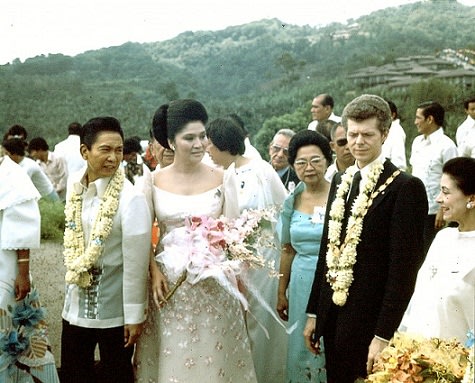
Van Cliburn became a familiar figure to the Filipinos back in the Martial Law era.  He frequently appeared in many cultural events upon the invitation of then First Lady Imelda Marcos and was warmly received by the music-loving Filipino audience.

Image credit: http://ph.news.yahoo.com/
Cliburn is also remembered for performing in a fund-raising concert for the Young Artists Foundation, an arts foundation which provided support to then aspiring musicians Cecile Licad and Rowena Arrieta, and Noel Velasco. He also performed in several other fund-raising concerts; of note was the concert in Araneta Coliseum which drew rave reviews despite not having the benefit of a rehearsal.

Retirement and legacy

Cliburn announced his retirement in 1974, following the death of his father, and completely stopped touring in 1978.  This, however, did not prevent him from helping in the cause of discovering and supporting young musicians.  He was a staunch supporter of the Van Cliburn International Piano Competition, an eponymous non-profit enterprise which offers promising concertists a shot at winning cash prizes, a Carnegie Hall debut, and a two-year tour promoted by the competition.


"An artist can be truly evaluated only after he is dead. At the very 11th hour, he might do something that will eclipse everything else." - Van Cliburn


Wednesday, February 20, 2013

Shakespearean Delights: PPO pays tribute to the "Bard of Avon"

“Love like a shadow flies when substance love pursues
Pursuing that that flies, and flying what pursues.” 
― William Shakespeare, The Merry Wives of Windsor

Boasting of a lineup that features music inspired by the literary works of no other than the "Bard of Avon" himself, PPO's latest offering is as Shakespearean as any concert could get.

The Philippine Philharmonic Orchestra (PPO), led by its musical director Olivier Ochanine, is finally set to stage its sixth show for its 30th concert season. The concert, themed "Shakespearean Delights," is slated on February 22, 2013, 8PM, at the Tanghalang Nicanor Aberlardo of the Cultural Center of the Philippines.

In keeping with its title, the concert's repertoire was tailored to include orchestral works inspired by literary masterpieces from William Shakespeare's oeuvre. The programme consists of  Otto Nicolai’s “Overture to the Merry Wives of Windsor,” Felix Mendelssohn’s “A Midsummer Night’s Dream,” and William Walton’s “Suite from Henry V”.

An exception to this Shakespearean streak, however, is Edvard Grieg's piano concerto in A minor, op. 16 to be performed by internationally renowned Filipino pianist Albert Tiu.  Tiu was invited to perform as a guest soloist in lieu of Korean soprano Hyunah Yu, who canceled her appearance within a short notice due to emergent medical concerns.

Pianist Albert Tiu

For ticket information, visit http://culturalcenter.gov.ph or contact the CCP Box Office at (02) 832-3704.

Saturday, February 2, 2013

The Poet Speaks: A pre-Valentine treat from tenor Arthur Espiritu and pianist Najib Ismail


Can't wait to get all romantic on Valentine's Day? Warm up for the month's most anticipated celebration with some of classical music's most romantic songs delivered by two top brass Filipino musicians.

The Manila Chamber Orchestra (MCO) Foundation opens its 2013 Chamber Music Series with a concert entitled "The Poet Speaks" top billed by lyric tenor Arthur Espiritu and pianist Najib Ismail on Februray 6, 2013, 7PM at the Ayala Museum.  

Arthur Espiritu, hailed by critics to be the finest Filipino tenor in the world today, returns to the Philippines after his successful series of highly acclaimed performances as the Duke of Mantua in Verdi's Rigoletto at the Theatre St. Gallen in Switzerland.  This serves as another one of Espiritu's homecoming projects following his performance as Count Almaviva in last year's full-length production of The Barber of Seville at the Cultural Center of the Philippines.

Accompanying him at the piano is Najib Ismail, one of the country's most respected vocal repetiteur and chamber musician.  He took his undergraduate studies at the UST Conservatory of Music and pursued further studies in vocal accompaniment and operatic repetiteur at the Hong Kong Academy of the Arts. He is currently serving as a faculty at the UST Conservatory of Music.

The concert will feature Robert Schumann’s Liederkreis, Op. 39, Franz Liszt’s Three Petrarch Sonnets, S.270, and several arias from various operas.  Perfectly aligned with the upcoming Valentine's Day celebration, the repertoire promises to take audiences on a romantic ride as it attempts to explore the different aspects of love.

A portion of the proceeds from the ticket sales will be for the benefit of Unang Hakbang Foundation, a child-centric charitable organization.


Order your tickets by calling Ticketworld at (63 2) 891-9999, MCOF Secretariat at (63 2) 750-0768 or (63 920) 954-0053 and COEA at (63 2) 782-7164 or (63 918) 347-3027.

Thursday, January 31, 2013

Pasinaya 2013: A celebration of Tsinoy culture


With over 3,000 participating artists and 120 shows that cascade throughout the day in CCP's different halls and theaters, Pasinaya 2013 is a cultural celebration like you've never seen before.

The annual CCP Open House Festival, Pasinaya, is considered to be the largest one-day multi-arts festival in the country.  This year, the festival's theme is "Tsinoy!" and focuses on the Filipino-Chinese arts and culture.  There will be a wide range of shows to choose from: music, theater, dance, visual arts, film, and even literature.

All of CCP's nine resident companies will lead the performances, accompanied by various performing and art groups from Metro Manila and other regions.  Several Tsinoy talents, like singers Eva Marie & Richard Poon, opera singers Sherwin Sozon & Elaine Lee, and award-winning pianists Hansel Harel Ang & Denise Faith See will grace the stages with short albeit entertaining programs.  Also scheduled to perform are renowned Tsinoy performing groups Ling Nam Athletic Federation, Lion Cubs, and Philippine Buddha Care.

Apart from cultural performances, there will also be exhibits on Chinese traditional medicine, Chinese languages, Chinese horoscopes, and authentic Chinese street foods called "Komida Tsina".

Over 50,000 people are expected to attend this year's Pasinaya festival.  Hope you can all come and join the fun!


For more information, visit www.culturalcenter.gov.ph.

Wednesday, January 9, 2013

Lorenzo Medel plays Rach 2 with MSO


Following his successful AHA debut last December 6, 2012, piano prodigy Lorenzo Medel is once again set to conquer the stage as he performs in a solo piano recital on January 12, 2013 at the Philamlife Auditorium, UN Avenue, Manila. He will be assisted by the Manila Symphony Orchestra (MSO) under the baton of Prof. Arturo Molina.

The programme consists of pieces from divergent periods and styles, with selections from Liszt, Chopin, Bach, Bartok, Abelardo, Beethoven, and Rachmaninoff.  Medel will be playing Beethoven's tempestuous piano sonata no. 23 in F minor, or more commonly known as the "Appasionata."

The concert's centerpiece, however, is Rachmaninoff's Piano Concerto no. 2 in C minor, a well-loved classic which is considered to be a staple in many a pianist's repertoire. For a preview of Medel's "romantic" interpretation of the piece, here is a video taken during his recital last December 6, 2012 at UP Diliman's Abelardo Hall:


At the young age of 17, Lorenzo Medel is now at the vanguards of the Filipino classical music scene and is hailed by many critics as "one of the most promising young Filipino pianists today." He has also received many accolades from various award-giving bodies, including the National  Music Competition for Young Artists (NAMCYA), the Piano Teachers' Guild of the Philippines (PTGP) annual piano competition, and the UP College of Music Piano Competition.  He was also the country's representative during the Steinway Competition held at Yong Siew Toh Conservatory of Music in Singapore. To date, he has given over 10 solo recitals, many of which received critical raves from some of the country's most respected music pundits.

Lorenzo Medel studies piano under the tutelage of Professor Mauricia D. Borromeo, former dean of the University of the Philippines College of Music.


For ticket reservations, contact the MCO Foundation at 750-0768 or cel. no. 0920-954-0053.

Wednesday, November 7, 2012

Things to get you stoking: What to expect in PTGP's Forte @ 40


With barely 2 weeks left until the PTGP's much-awaited Forte @ 40 concert, more people are finding themselves increasingly psyched up for this budding mega event. What has previously been grapevine information transmitted via hushed undertones is now a full-blown hype that's taking traditional and social media by storm.

Looks like everyone's stoked ... and rightfully so.

Just so the buildup doesn't come across as a vain attempt to oversell the whole thing, here's a rundown of the pretty cool things to expect come November 18 (and ostensibly, reasons why it should NOT be missed):


1) It features 40 pianos. Enough said.

And when you thought the 10 pianos in UST's annual "Sampung Mga Daliri" wasn't ambitious enough, try chocking up 40 in CCP Main Theater's stage. A concert of this magnitude is previously unheard of in our country; heck, it was even thought of to be impracticable at the very least! Well guess what? PTGP pushed the envelope to put all these qualms to rest. The sheer boldness of this undertaking had many people approaching me with manifest uncertainty and asking, "Hey Ludwig, is this concert even possible? How the hell would they fit 40 pianos in a single stage?"

I'd just shrug my shoulders and say, "Well, you better attend the concert to find out."

2) Piano-rapping eight year olds and stage-rocking grannies.

Yep. And a whole army of 'em too.

Apparently, PTGP wasn't bluffing when it claimed to round up as much as 300 pianists just for this concert.  And because the event celebrates four decades of piano pedagogy excellence, expect a conglomeration of only the best home-grown pianists available.

Audiences will get to see bigwigs such as the likes Dr. Raul Sunico, Harold Galang, and Fr. Manuel Maramba. And of course, expect a LOT of wunderkinds whose skills border the unreal. (This coming from an embittered 21-year old who can barely clunk chopsticks on the keyboard.)

3) Great, great music from divergent musical styles

Whether you're a faithful Mozartian classicist or a hardcore '90s rock connoisseur, you're sure to enjoy as this concert promises to dish out numbers that slake each one's discriminating musical tastes.

The repertoire consists of ten pieces that well represent Baroque, Classical, 20th century, Pop, and Filipino styles. I, for one, am particularly looking forward to watching Ryan Cayabyab's "Pop Medley."  With its lush harmonies that are distinctively Cayabyab and its dazzling display of virtuosity, this piece is truly a joy to behold.

One of the most interesting pieces lined up for the concert is "Contagion," a fantasy ensemble piece for eight pianos based on Nirvana's 1991 chart-topping hit, "Smells Like Teen Spirit." This magnum opus is penned by Kabaitan Bautista, a young up-and-coming Filipino composer whose flair for the avante-garde turned this headbanger anthem into a pianistic masterpiece.

The main course, however, remains to be the world premiere of Augusto Espino's "Mga Gintong Pamana."  Commissioned by the PTGP solely for this commemorative event, it is, according to the words of PTGP President Anthony Y. Say, "the finale and the most complex work [in the entire repertoire] as it is a compilation of Filipino works that were handed down to the succeeding generation and which we will be handling down to the next generation.”

4) Memories to last a lifetime.

At this point, I ask you to puh-lease cut me some slack for ending on such a sappy note.  After all, if not for anything else, this IS a once-in-a-lifetime experience.  It is an event that will be the meat of colloquies for the years to come; and much like any other "rare opportunity," it is something that when let past, can never be brought back again.

'Til then, we can only hope for a concert sequel featuring 50 pianos.  But since I'm no Madam Auring, I won't be taking any chances and I WILL watch this show by hook or by crook.


To order your tickets, call TICKETWORLD at (+63 2) 891-9999 or visit Ticketworld.com.ph.

Wednesday, September 5, 2012

300+ pianists prep for record-breaking piano concert


Across the hall, necks craned and twisted to catch the facilitator’s cue.  Upon the indicative motion of the facilitator’s hand, a choreographed army of hands began to play in perfect synchrony. From the digits of children as young as eight to those whose crowns screamed out experience , music flowed in a relentlessly rapturous flourish—for this is, indeed, ensemble ... in the truest sense of the word.


Thus begins the journey towards the much-awaited grand 40-piano concert on November 18 this year at the Tanghalang Nicanor Abelardo of the Cultural Center of the Philippines. 

The monumental concert, which serves as the centerpiece of the Piano Teachers' Guild of the Philippines' (PTGP) Ruby Jubilee, is the first of its kind in the Philippines, breaking all previous records  for the most number of pianos in a single ensemble performance.  During the event, 40 pianos—10 grand and 30 upright—will be strategically set-up on stage and as many as many as 80 pianists will be playing simultaneously. 


The concert is participated in by students, teachers, concert artists, and even past competition winners—all of whom have contributed to the colorful 40-year history of the guild.

To ensure its success, PTGP officers have scheduled practices as early as July, working their way towards the auspicious event.  For the past weeks, rehearsals were slated and conducted at the Steinway Hall of Lyric Piano & Organ Corporation—one of PTGP's partners in the landmark occasion—in New Manila, Quezon City

A total of 320 participants are expected to grace the stage during the grand culminating activity, including internationally-renowned pianists such as Dr. Raul Sunico, Ross Salvosa, and Harold Galang; and budding concertists like Lorenzo Medel, Gabriel Allan Paguirigan, and Ma. Regina Montesclaros.


For more information, visit PTGP's official blog or like their Facebook page.

Friday, August 10, 2012

Matthew Calderon: Bringing the Filipino heart into the international stage


When somebody would ask me, "What have you accomplished at the age of 15?," I go blank.  Deploringly, the only memories I have from when I was a 15-year old would be that of chasing skirts and watching anime.  So I guess much like everyone else, my teenage years were pretty uneventful.

This certainly does not hold true for Matthew Calderon.  I bet that if he would be asked the same question, he would sit upright, chin held high, and haughtily answer back, "I won in an international piano competition at the age of 15."

But it doesn't seem fair to prejudice this surprisingly unassuming child wonder. As evidenced by this interview, there is so much more to him than meets the eye.  Join me as we discover what lies behind the internationally winning facade of Matthew Calderon--his beginnings, his competition experience, and his future plans.


When did you start learning the piano, Matthew?

I started playing the piano when I was 6.

Wow.  That’s a long time.  But even so, I 'm still curious on how you go about the preparation process. In light of your 2nd place win in your category during the 2nd Thailand Mozart International Piano Competition held last June, just how did you gear up for a competition of such caliber?

I practiced and practiced smart. <insert smiley here>

What were the pieces that you played during the competition?

Bach's Prelude and Fugue in C Minor no. 2 book , Mozart's Piano Sonata in C K330, Brahm's Rhapsody in G minor Op. 79, and Schumann's Aufschwung (Soaring) from Phantasiestucke Op. 12

Gee, those are tough pieces (From my vantage point, they really are. You know what they say, "If you can't pronounce it, you cannot play it.").  But apart from the technical difficulties that your pieces presented you, I would like to believe that the experience per se has brought its own set of challenges on you. What were the things that you got to learn from the experience?

I learned a lot from the experience, this being my first international piano competition.  I realized how much harder I still have to work and I was also inspired by the other young pianists from other countries.

I heard that you had some sort of an exacerbation before you went to Thailand for the competition?

Yes.  Before I left Manila I had an asthma attack and I didn't feel well in my first 2 days in Bangkok.  My teacher saw that I wasn't my usual self probably because of the medicines I took, so we made adjustments the day before the competition.

Aww. A mishap almost! That’s gotta be difficult. So how did you fare during the competition proper?

During the semi-finals, I was nervous naturally, but I kept in mind what teacher Mary Anne said, that I should just enjoy my performance.  It was a bit difficult when I began to play the first piece, but eventually, I began to enjoy it.

And what was you standing in the semi-finals?


Out of 7 semi-finalists, only two advanced to the finals, a girl from Malaysia, and me.

Wow! I bet you breezed through the finals.

Well, almost.  During the finals, I was more relaxed because I was just thankful and happy that I made it that far.  I did my best knowing that if I would win, it would just be a bonus already.

So I guess you won? <facepalm>

I was the only winner in my category.  I couldn't believe it.  I was happy, and I was humbled.


Matthew Calderon (far right) together with fellow Filipino winner,
Denise See (second from the left) during the awarding ceremonies.


The judges must've thought you were  the only one truly deserving of any distinction.  It's unquestionable.  But I was just wondering ... what did you think of the performances of your competitors? Did you get to hear how they played?

I didn't stay in the competition hall so I didn't hear the other contestants play.  It was only during the winner's concert when I heard some of them.  I had several realizations- the value of slow practice and lots of practice both actual and mental.

How did you feel when the results were being announced?


The results were just posted and I was almost afraid to look.

But what the heck, you won!  And the lone winner at that!  Your support crew must have been so proud.

Actually, I am really grateful for the unselfish support of my teacher.  She was a true mentor in every sense of the word.  My parents also came with me and my sisters cheered me on through the internet.  The other Filipino contestant, Denise See, and her mom were also very supportive.  My schoolmates and teachers also supported me and also some teachers from PTGP.

I am sure they all did their best to pep you up during such a crucial moment.  All their efforts to bolster your morale surely paid off.

Do you have any other realizations from the experience?

I also saw what I had in common with Denise, the other Filipino contestant- the Filipino heart.

What are your plans for the future?

Right now, I am in my third year at the Philippine High School for the Arts.  My teacher and I have begun preparing for my graduation recital. After that, I plan to pursue a college degree in music.

In what particular school, if I may ask?

I will just explore the opportunities that hopefully will come my way.

Well, good luck then. I wish you all the best for the future! Thank you for doing this interview with me.

Thank you very much po for this interview .


Matthew is currently under the tutelage of Ms. Mary Anne Espina. Prior to his Thailand victory, he was a regular performer and competitor in the various festivals and competitions sponsored by the Piano Teachers Guild of the Philippines (PTGP).